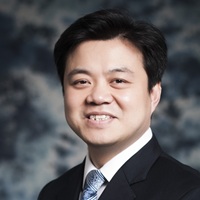
Prof. Yiqiang Chen, University of Science and Technology of China, China
Speech Title: MoFedNet: Large-Scale Heterogeneous CPS Multi-Agent Collaboration (模联网:大规模人机物异构多智能体协同)
Chen Yiqiang (Fellow, IEEE) is currently the Deputy Director of the Institute of Computing Technology, CAS, and serves as the Director of the Beijing Key Laboratory of Multimodal Collaboration and Advanced Application. He also serves as a member of the National Key Research and Development Program of China Expert Group on "Modern Services" and "BT and IT Fusion." He has been recognized as a national-level leading figure in technological innovation, a leading figure in science and technology innovation for young and middle-aged professionals by the Ministry of Science and Technology, and a rising star in technology in Beijing, among other honors. His primary research areas include Artificial Intelligence, Ubiquitous Computing, and Federated Learning. He has achieved notable results in research on multi-modal high-precision perception, cross-modal fine-grained correlation, intelligent diagnosis models for ophthalmology and brain disorders, and federated learning platforms. He has published over 200 papers in international journals and conferences, receiving 7 Best Paper Awards. He has been awarded the Second Prize of the State Science and Technology Progress Award, as well as the First Prize in the 2017 CCF Technical Invention Award (ranked first), and the Second Prize for Technological Progress in Beijing for two consecutive years in 2015 and 2016.

Prof. Tao Zhang, Macau University of Science and Technology, China
Dr. Tao Zhang is a Full Professor at the School of Computer Science and Engineering, Macau University of Science and Technology (MUST), Macau SAR. He earned his Ph.D. in Computer Science from the University of Seoul, followed by a one-year appointment as a Postdoctoral Research Fellow at The Hong Kong Polytechnic University. He also holds a B.S. in Automation and an M.Eng in Software Engineering from Northeastern University, China. Dr. Zhang serves as the Founding Chair of the IEEE Computer Society Macau Chapter and is the Conference Chair for the IEEE Computer Society Technical Committee on Software Engineering (TCSE). He is a Fellow of the British Computer Society (BCS), a Senior Member of both ACM and IEEE, and a Distinguished Member of the China Computer Federation (CCF). He has also been named a Distinguished Visitor of the IEEE Computer Society. With over 100 publications in leading journals and conferences in the fields of software engineering and security, his work has appeared in venues such as ICSE, ESEC/FSE, ASE, TSE, TOSEM, EMSE, JSS, IST, TIFS, TDSC, and TSC. Dr. Zhang has held leadership roles as General Chair for numerous academic conferences, including ISSRE 2027, APSEC 2025, and SANER 2023. He also regularly serves as a Program Committee member for top-tier software engineering conferences such as ICSE, FSE, ASE, and ISSTA. In his editorial roles, Dr. Zhang is an Associate Editor-in-Chief of IEEE Transactions on Software Engineering (TSE). He also serves as an Associate Editor for IEEE Transactions on Reliability (TRel), the Journal of Systems and Software (JSS), and the IEEE Open Journal of the Computer Society (OJCS). Additionally, he is an Editorial Board Member of Empirical Software Engineering (EMSE) and Science of Computer Programming (SCP)
Speech Title: Intelligent Software Reliability and Security: Past, Present, and Future
Abstract: Software reliability and security have become more important for software quality. In the previous studies, scholars tend to utilize traditional methods such as static analysis and machine learning to resolve them. However, these kinds of approaches cannot deeply capture the semantic relations between source code and the context of software artifacts. In this new era, generative AI can help automatically produce more reliable source code, patches, commits, code comments, and responses to user reviews by deeply analyzing the semantic relations between natural language and programming language. For achieving the best performance of software reliability and security, a lot of scholars walk through a long road. For our team, we started from the initial reliance on bug reports or user review information to perform a single automated software reliability and security task. By establishing a unified neural network model and a unified representation model for bug reports, we constructed a set of methods that can achieve multiple automated software reliability and security tasks. In the process, we discovered the over-interpretation problem of pre-trained language models when implementing automated software reliability and security tasks, and proposed mitigation strategies. Following this way, depending on the huge power of LLMs, we proposed a series of new models and corresponding tools to enhance the performance of automated software reliability and security tasks. In the future, we will utilize Agentic AI with traditional software engineering approaches to further enhance the explanation of AI systems so that future AI software can produce accurate and explanatory results.